The National Magazine of RecordFounded San Francisco 1967 · New York since 1978
Tumbling Pebble
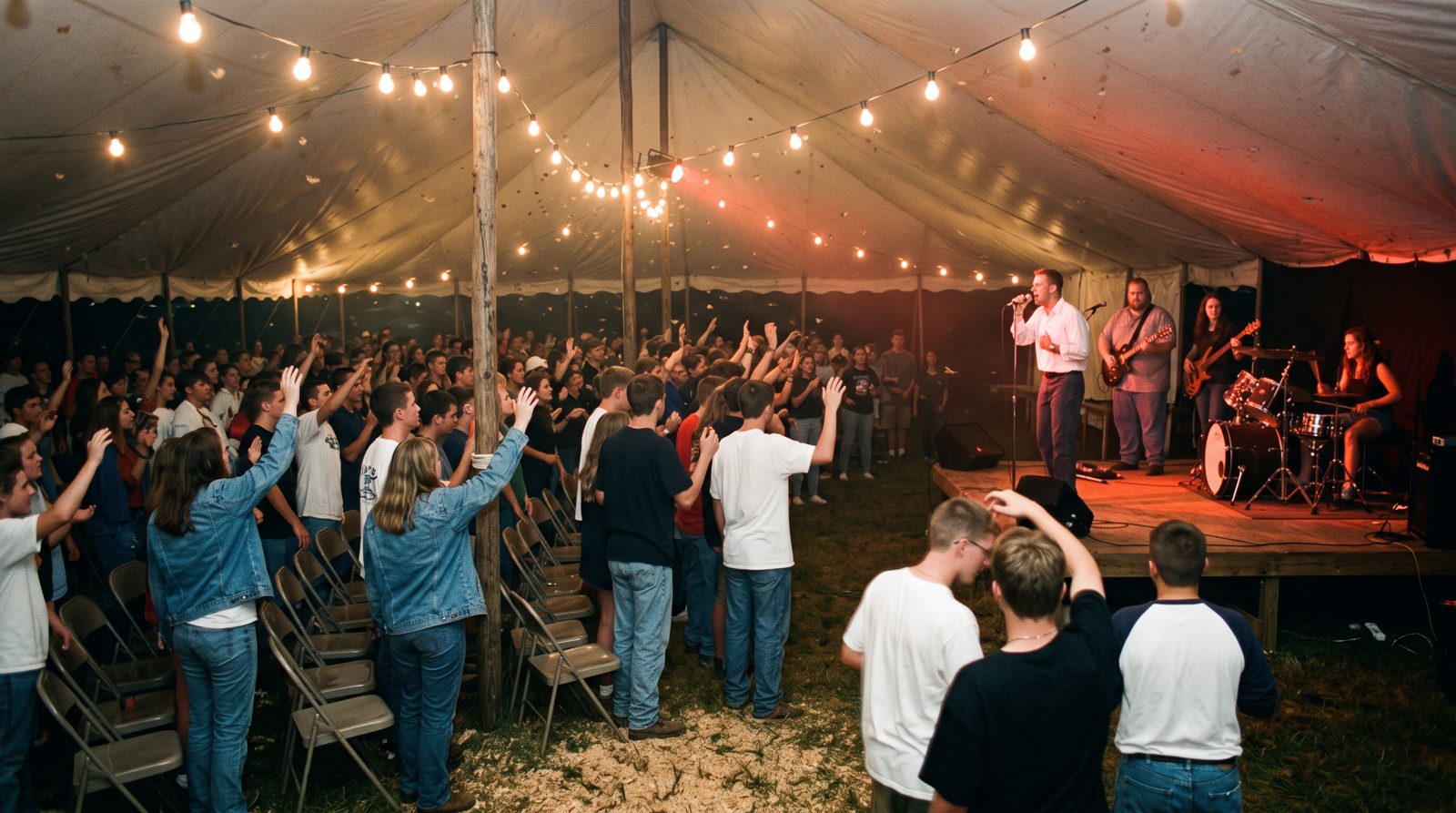
Church of the Holy Donut playing under a revival tent at night
Tumbling Pebble
No. 756August 22, 1996$2.95
  • Sass Master Flash: Non-Negotiable
  • Twelve copies from Tulsa
  • Below Minimums
Church of the Holy DonutThe Sign Was On

Cover photograph courtesy of Church of the Holy Donut.

No. 756 · Thursday, August 22, 1996 · $2.95

August 1996

Recovered by the archive October 22, 2026.

Contents

Feature

Church of the Holy Donut

The Sign Was On

A Winston-Salem hard rock band plays churches, revival tents and youth rallies and hands a donut to everyone who stays to the end. Its second record is the loudest act of faith we have heard this year.

The band recording in a church basement with a four-track machine
The basement, February 1994. Four weekends. Three ceiling tiles. Photograph courtesy of Church of the Holy Donut.

Fifteen minutes before Church of the Holy Donut plays, Pastor Vernon Whitley walks the room. He checks that the folding chairs are in rows. He confirms that the exit signs are lit. Then he takes a seat on the aisle. By then Deacon Lloyd Branch, who arrives half an hour ahead, has turned on the board, checked every channel, run a test tone and set the levels, and he does not touch them again for the rest of the night. At the Piedmont Youth Rally in Greensboro this spring the arrangement was the same, except that there were more chairs.

The band began in the fall of 1993 at the Sister Glaze on Patterson Avenue, in Winston-Salem, the first shop of the chain, where the red FRESH NOW sign in the window comes on when the glazed donuts are hot. Gerald Pickett, who was thirty-one, pulled in because the sign was on. Ray Stubbs, who works at the shop and has smelled like a bakery since 1987, sat down beside him and explained the conditions. Gerald said it was a metaphor. Ray said it was probably both. Gerald wrote the first verse of a song on a napkin that night. The napkin is framed above the door of his church office.

Gerald said it was a metaphor. Ray said it was probably both.

Gerald sings and, by his own description, handles the theology. Donna Pickett plays bass and sings, and lands the last note of every song a half beat after everyone else, a clean landing after the others have touched down; Gerald writes the endings to leave room for it. Ray Stubbs plays guitar in drop D with a tone like bread dough, low and kneaded and warm even at volume. Carol Ann Dupree plays drums. At the end of every show she stands up from the kit, takes the tape off her sticks, lays it on the snare and goes to get a donut.

They recorded their first album, The FRESH NOW Sign, in the basement of New Covenant Baptist Church over four weekends in February 1994. Pastor Whitley had given permission on condition that the band not damage the ceiling. Three tiles were damaged. The album was mastered in Greensboro by an engineer who had also mastered two regional death metal records, and who described Carol Ann's kick drum as appropriate for the subject matter.

The new one is Glazed and Forgiven, on Risen Dough Records. The songs are longer and the dynamics heavier. The title track holds Donna Pickett's first recorded scream and Carol Ann Dupree's most celebrated passage: thirty-two bars of double kick drum at 172 beats per minute. Our reviewer has a phrase for it, below, and we will let it stand.

At the end of every show Gerald Pickett steps down off the stage with the boxes and hands out donuts himself, one at a time, looking each person in the eye. The boxes come from the Patterson Avenue shop by way of Travis Muncie, who works the late shift there and brings them when it ends. At the band's first show, the story goes, a deacon with concerns about the theology came, stayed to the end and ate the donut. He has not raised the concerns again.

This is a secular publication. We note it for the record. We also stayed to the end in Greensboro, and accepted the donut, and it was, as the band would say, correct.

A church fellowship hall set with folding chairs before a show
The fellowship hall, before doors. Chairs in rows. Exit signs lit. Photograph courtesy of Church of the Holy Donut.

Records

Reviews in this issue. Stars as awarded.

Glazed and Forgiven

Church of the Holy Donut · Risen Dough · 1996

It is either the most sincere or most absurd thing we have heard this year, and by the fourth listen we had stopped needing to decide. The Winston-Salem band's second record is heavier, longer and better than the first. Ray Stubbs's drop-D guitar is a warm, low wall; Donna Pickett's first recorded scream arrives exactly when it should. Carol Ann Dupree's thirty-two bars of double kick at 172 beats per minute on the title track are theologically load-bearing. "Patterson Avenue" is a hymn to a street corner and means every word.

Teresa Vail

The Ancient Ones Know Our Name (They Don't)

God's Lunatics · Kvlt Nonsense · 1996

A CD-R from a black metal band in Tulsa, Oklahoma, issued in an edition of twelve. We have one. We are told nine are known to survive, and ours is one of the nine. Terry Mullins screams with real conviction about winters considerably colder than any in Oklahoma, and Dale Hensley's drumming is fast, committed and recorded in what sounds like a garage, which it was. Whether or not the ancient ones know the band's name, the band knows exactly what it is doing. Hard to find. We would not try to talk you out of it.

Leon Szabo

Below Minimums

Red Screen of Death · Hobbs Time · 1996

The Prescott, Arizona, thrash band's second record, made in a real studio in Phoenix after a debut cut in a flight simulator bay. This is the one where they got better. Wes Tarkanian's guitar tone was, we are told, two months and most of a student loan in the making, and it was worth every hour. More important, Danny Ocampo has stopped shouting and started briefing, and the songs make sense as a result: "The Impossible Turn," "Task Saturation" and "Behind the Airplane" are about the mistakes pilots are trained to avoid, sung by people who are training to avoid them.

Frances Odegaard

Non-Negotiable

Sass Master Flash · Flash in the Pan · 1996

Recorded after the first request to dial it back. Nothing was dialed back. The Atlanta band's fourth record is its most composed and its most commanding: Tasha Merriweather sets out the terms on "Terms," restates them on "Non-Negotiable" and declines a counteroffer on "Counteroffer Declined," and the band behind her, with Lorraine Pugh's keyboards newly forward, is the tightest in Southern hip hop. "Auburn Avenue" is a love letter. "Closing Statement" is the last word, and it is meant to be.

Ruth Abernathy

Letters

Correspondence

Sir: In your December issue your correspondent stated that the GAU-8 fires at up to 3,900 rounds per minute. This is correct. I wished to say so.

— Name withheld, Tucson, Ariz.

Sir: In the same issue you reported that the Council of Sleep declined a recording contract with the words "We appreciate the letter." The Council has received your subsequent letter requesting an interview. We appreciate the letter.

— D. M., Taos, N.M.